
Author: Leanne Gaul, CA, Ex-Financial Planner, UTS Academic and Sustainability Researcher
Investment & Sustainable Business Outlook Article: 1 Issue:1 Volume: 1 2026 ISSN: 2982-3226 (Print) ISSN: 2982-3234 (Online) www.accountingbusinesscare.com.au
Abstract: Our planet is on the verge of ecological imbalance. Our social justice, social equity, and economic prosperity are all outcomes and subsets of our planet’s ecological balance. The current state of ecological imbalance is due to anthropogenic economic activities and other human-induced factors, resulting in multiple interconnected risks worldwide.
The return of our business and investment is dependent on these risk factors. If the ecological health of our planet declines, both our present and future social justice, equity, and economic prosperity could be jeopardised. It is time to be a prudent investor by incorporating a sustainability perspective in investment decision-making so that capital allocation for business investment follows the principles of sustainable finance frameworks as laid out in The Principles for Responsible Investment (PRI), Principles for Sustainable Insurance (PSI), Equator Principles (EI), and Principles for Responsible Banking.
Hence, a community of sustainable investors can act as a catalyst for changing the mindset from business- as-usual.
Key words: Sustainability, sustainable finance, sustainable investors, green investors, social impact investors, sustainable investment strategy, climate change, global risks, ESG Risk
Citation: Gaul, L. (2026) ‘Why must you be an informed sustainable investor?’ in K. Goswami (ed.) Investment & Sustainable Business Outlook, Article: 1, Issue:1,Volume:1 pp. 01-20, https://accountingbusinesscare.com.au/investment-sustainablebusiness-outlook/ or https://accountingbusinesscare.com.au/informedsustainable-investor/
Introduction
Over three decades of my professional and academic experience as a CA, an ex-financial planner, an academic, and a researcher have provided insight into the influential roles of investors and stakeholders in changing business practices towards sustainability values. In recent years, investors have realised the rationality of sustainable investment practices, as it promotes economic prosperity by mitigating environmental degradation and advancing social justice.
In this article, I have provided my normative argument for sustainable investment as a finance professional and as a sustainability advocate. It is important to highlight that this is general advice only. I recommend that, before investing, one should seek professional financial planning advice and invest based on one’s personal risk appetite and financial circumstances.
What is sustainable investing?
The term “sustainable” derives from the “sustainability concept”; hence, “sustainable investors” are those whose investment decisions incorporate economic, environmental, social, and governance factors (Marszk & Lechman, 2023).
In recent years, the sustainable investment market has experienced noticeable growth, leading to a range of new sustainable financial products, including sustainable equity funds, sustainable index funds, sustainable bonds, green bonds, climate action bonds, social bonds, and sustainable loans. Figure 1 depicts the basic characteristics of these sustainable investment options.
Within the broader sustainable investor community, there are various subgroups: green investors, climate action investors, and social impact investors.
Green investors are those whose investment interests are focused on positive environmental outcomes such as resource management, pollution control, waste management, ecosystem conservation, and restoration (Stein, 2024, October 1). Within the green investor community, the climate action investor sub-group focuses on climate mitigation and adaptation-related outcomes aligned with the objectives of the Kyoto Protocol and the Paris Agreement. Climate action investments aim to fund organisational activities to reduce greenhouse gas (GHG) emissions (as GHG emissions lead to rising global temperatures) or to fund green infrastructure (United Nations, n.d.-b). Green investors make investment choices that incorporate climate action and other favourable environmental outcomes, in addition to financial benefits to the investor.
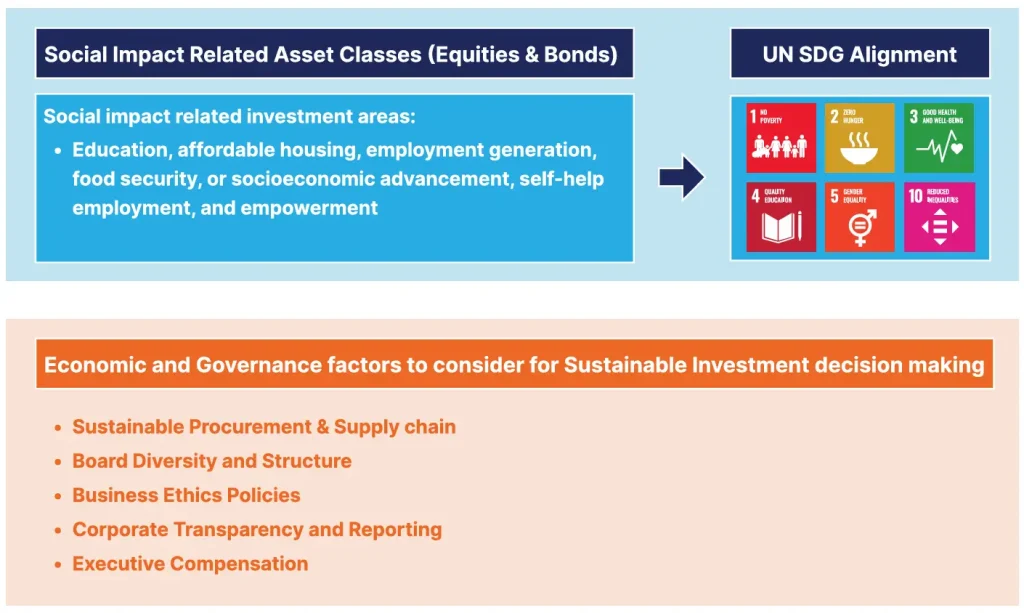
Social impact investors seek a positive social impact in education, affordable housing, employment generation, food security, or socioeconomic advancement and empowerment, in addition to the financial benefits of the investment. The beneficiaries and stakeholders of the social impact investment can include supply chain stakeholders, local communities, vulnerable groups, customers, and broader society (Anheier et al., 2010). Commonly positive social impact themes are diversity, equity, inclusion, and modern slavery (World Economic Forum, 2022, June).
In addition to environmental and social factors, a sustainable investor also needs to consider other economic and governance factors: sustainable procurement and supply chain; board diversity and structure; business ethics policies; corporate transparency and reporting; and executive compensation.
The 2025 Global Risk Report (as shown in Figure 3) also reflected a similar trend. The report presented the top 10 global risks by severity. In the short term, two of the top 10 severe risks will arise from environmental categories, whereas four of the top 10 severe risks will arise from societal risk categories. However, in the long run, the severity of environmental risks will worsen, as five of the top 10 severe risks will stem from environmental categories. In contrast, at the same time horizon, two of the top 10 severe risks will be driven by societal factors.
Why should one be a sustainable investor?
Our society and economy are the subsystems of our ecology; hence, living within the ecological boundaries of our planet is the most prudent decision. However, due to over-extraction and other negative impacts of our economic development, the fragile balance of our ecology is at significant risk.
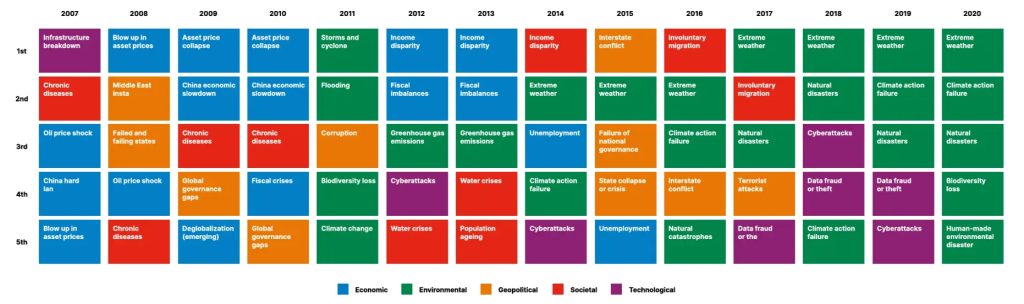
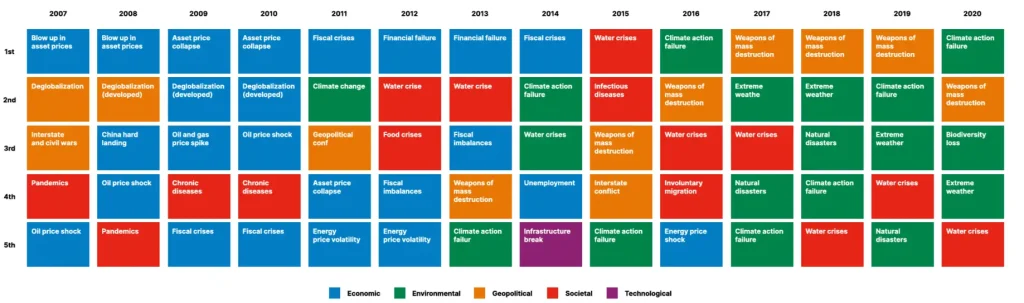
This fact is also evident in the World Economic Forum’s Annual Global Risk Reports. Every year, the World Economic Forum presents the risk perceptions of global leaders and experts on geopolitical, environmental, societal, and technological challenges across the short-, medium-, and long-term horizons.
A trend analysis of risk perception from 2007 to 2020 (as shown in Figure 2) revealed that, since 2011, on average, two to three environmentally related risks, in terms of likelihood and impact, have appeared in the top five of the global risk perception table.
The 2025 Global Risk Report (as shown in Figure 3) also reflected a similar trend. Thereport presented the top 10 global risks by severity. In the short term,two of the top 10severe risks will arise from environmental categories, whereas four of the top 10 severerisks will arise from societal risk categories. However, in the long run, the severity ofenvironmental risks will worsen, as five of the top 10 severe risks will stem fromenvironmental categories. In contrast, at the same time horizon, two of the top 10 severerisks will be driven by societal factors.
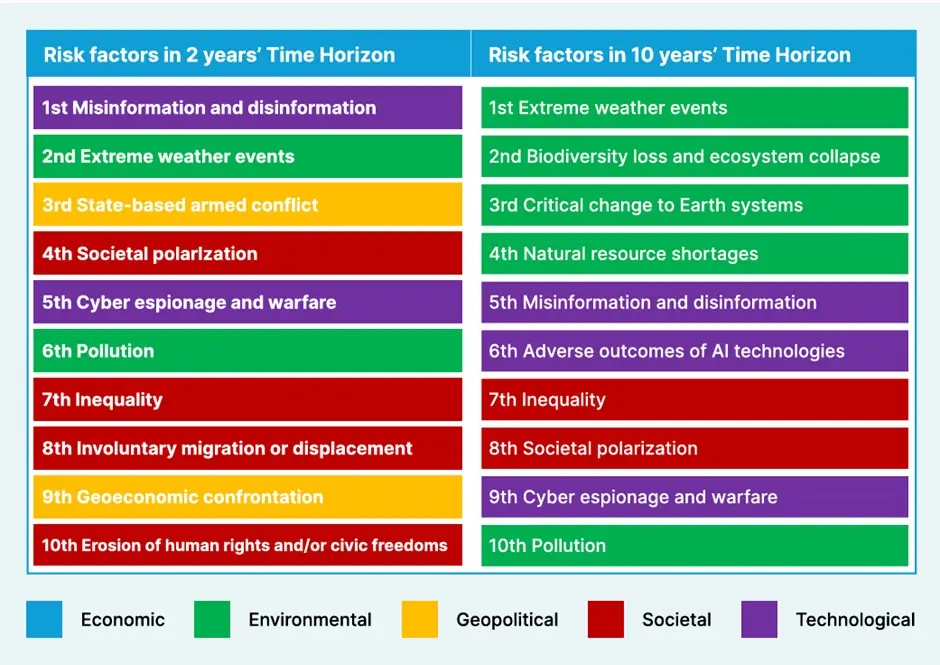
These worsening environmental and societal risk perceptions underscore the urgency for businesses to embed sustainability values into their strategic decision-making frameworks and operational practices. These environmental and societal risk factors will continue to escalate, negatively impacting societal resilience (World Economic Forum, 2025).
Every investment in economic development has socio-ecological negative impacts; hence, our investment decision must embrace sustainability or ESG principles to safeguard our capital and returns from these risk factors and their consequential negative impacts. Hence, we must be informed, sustainable investors...READ MORE

Leanne Gaulis a Qualified Chartered Accountant, Ex Financial Planner, Academicand Researcher with a professional experience of 30 plus years. She has an academic background in economics, accountancy, and finance.
Currently, she is pursuing her PhD from theUniversity of Technology, Sydney. She is alsoassociated with Charles Sturt University andthe University of Technology as an Academic.
Previously, Leanne was associated with a major Australian Bank and financial services providers as a financial planner. Leanne Gaul is a passionate researcher in sustainability, stakeholder engagement, governance frameworks, codes of ethics, and risk management frameworks
Anheier, H. K., Toepler, S., &Anheier, H. K. (2010). Social Investment. In (pp. 1427-1431). Springer US. https://doi.org/10.1007/978-0-387-93996-4_617
ASX. (n.d.).ASX investment products monthly report Retrieved 4 May 2025 from https://www.asx.com.au/issuers/investment-products/asx-investment-products-monthly-report
Australian Accounting Standards Board. (2024, September 20). Australian Sustainability Reporting Standard. In AASB S1: General requirements for disclosure ofsustainability-related financial information [voluntary].
Bryan, A. (2020, September 3).Defining the universe of sustainable ETFs and indexfunds. Morningstar. Retrieved 4 May 2025 from https://www.morningstar.com.au/etfs/defining-the-universe-of-sustainable-etfs-and-index-funds
Cook, G., Dowdy, A., Knauer, J., Meyer, M., Canadell, P., & Briggs, P. (2021, November 29). Australia’s Black Summer offire was not normal-and we can prove it.CSIRO. Retrieved 14 April 2025 from https://www.csiro.au/en/news/all/articles/2021/november/bushfires-linked-climate-change
Cresswell, I., Janke, T., & Johnston, E. (2021). Climate change and extreme events (Australia state of hte environment 2021, Issue.
Cresswell, I. D., Janke, T., & E.L., J. (2021). Australia state of the environment 2021: Overview, independent report to the Australian Government Minister for hteEnvironment, Commonwealth of Australia, Canberra.
Doermann, L. (2025, March 7). Alfred’s strange and destructive journey. Earth Observatory. Retrieved 14 April 2025 from Environmental Justice Foundation. (2011).Fisheries and food security in the Commonwealth. https://ejfoundation.org/resources/downloads/EJF_food_security_report_low_res.pdf
Fecht, S. (2021, February 25). Climate: How exactly does carbon dioxide cause global warming? Retrieved 14 April 2025 from https://news.climate.columbia.edu/2021/02/25/carbon-dioxide-cause-global-warming/
Ganesan, R. (2025, March 18). Australia: Cyclone Alfred to cost economy $790m astourism faces long-term fallout.Asia Insurance Review. https://www.asiainsurancereview.com/News/View-NewsLetter-Article/id/91054/type/eDaily/Australia-Cyclone-Alfred-to-cost-economy-790m-as-tourism-faces-long-term-fallout
Gaul, L. (2025).Climate-related risks and other anthropogenic impacts on neurolocial disease in Australian communities. https://www.linkedin.com/pulse/climate-related-risks-other-anthropogenic-impacts-disease-leanne-gaul-hefgc
Global Reporting Initiative. (2020, March). Linking the SDGs and the GRI standards. Retrieved 4 May 2025 from https://www.globalreporting.org/media/lbvnxb15/mapping-sdgs-gri-update-march.pdf
Goswami, K., & Evers, W. (2022). Carbon accounting and sustainable finance: The newway forward. Australian Centre for Sustainable development research and innovation (ACSDRI), 4(1). https://acsdri.com/publications-on-sustainable-development/carbon-accounting-and-sustainable-finance/
Gou, X., Fu, Y., Li, J., Xiang, J., Yang, M., & Zhang, Y. (2024). Impact of nanoplastics on Alzheimer’s disease: Enhanced amyloid-βpeptide aggregation and augmented neurotoxicity. Journal of Hazardous Materials,465, 133518. https://doi.org/https://doi.org/10.1016/j.jhazmat.2024.133518
Hill, G., Ming, E., McMahon, G.,& Shen, D. (2024). KPMG energy transition-global investment outlook: 2025 and beyond. https://kpmg.com/kpmg-us/content/dam/kpmg/pdf/2024/energy-transition-global-investment-outlook-2025-beyond.pdf
Honan, K. (2025, March 17). Ex-Cyclone Alfred costs NSW farmers millions in stock lossand damage.ABC News. https://www.abc.net.au/news/2025-03-17/cyclone-alfred-cost-to-nsw-agriculture-17-million-and-rising/105059484
Insurance Council of Australia. (2025, March 17). Insurer update on ex-TC Alfred https://insurancecouncil.com.au/resource/insurer-update-on-ex-tc-alfred/
Integrated Reporting. (2021, June 9).IIRC and SASB form the Value Reporting Foundations, providing comprehensive suite of tools to assess, manage andcommunicate value. Retrieved 4 May 2025 from https://integratedreporting.ifrs.org/news/iirc-and-sasb-form-the-value-reporting-foundation-providing-comprehensive-suite-of-tools-to-assess-manage-and-communicate-value/
Lebreton, L., Slat, B., Ferrari, F., Sainte-Rose, B.,Aitken, J., Marthouse, R., Hajbane, S.,Cunsolo, S., Schwarz, A., Levivier, A., Noble, K., Debeljak, P., Maral, H. Schoeneich-Argent, R., Brambini, R., & Reisser, J. (2018). Evidence that the Great Pacific Garbage Patch is rapidly accumulating plastic. Scientific Reports, 8(1), 4666. https://doi.org/10.1038/s41598-018-22939-w
Lindsey, R. (2024, April 9). Climate change: Atmospheric carbon dioxide. Retrieved 14 April 2025 from https://www.climate.gov/news-features/understanding-climate/climate-change-atmospheric-carbon-dioxide
Marszk, A., & Lechman, E. (2023). Chapter 3 – Sustainable investing—main concepts. Sustainable investing ETFs: methodological and theoretical background. In A. Marszk & E. Lechman (Eds.), Sustainable Investing (pp. 55-110). Academic Press. https://doi.org/https://doi.org/10.1016/B978-0-12-823871-4.00008-8
Moseman, A., & Rothman, D. (2024, January 26). Ask MIT: How much carbon dioxide does Earth naturally absorb? Retrieved 14 April 2025 from https://climate.mit.edu/ask-mit/how-much-carbon-dioxide-does-earth-naturally-absorb
Mulhern, O. (2020, August 12). A graphical history of atmospheric CO2 levels over time. Retrieved 14 April 2025 from https://earth.org/data_visualization/a-brief-history-of-co2/
Organisation for Economic Co-operation and Development (OECD). (2025). Global outlook on financing for sustainable developement 2025: Towards a more resilient and inclusive architecture. https://www.oecd.org/en/publications/2025/02/global-outlook-on-financing-for-sustainable-development-2025_6748f647.html
Principles for Responsible Investment Association. (2025a). An introduction to responsible investment: Screening and exclusions. Retrieved 4 May 2025 from https://www.unpri.org/introductory-guides-to-responsible-investment/an-introduction-to-responsible-investment-screening-and-exclusions/12727.article
Principles for Responsible Investment Association. (2025b). The matic and impact investing. Retrieved 4 May 2025 from https://www.unpri.org/investment-tools/thematic-and-impact-investing
Ritchie-Tyo, L., Dowdy, A., & Ramsay, H. (2025, March 6). Cyclone Alfred is slowing – and that could make it more destructive. Here’s how climate change might have influenced it. CSIRO. Retrieved 14 April 2025 from https://www.csiro.au/en/news/All/Articles/2025/March/Climate-change-cyclone-alfred
Sentinel, L. C. (2024, April 23). Vastly bigger than the black summer: 84 million hectares of northern Australia burned in 2023. The Conversation. https://theconversation.com/vastly-bigger-than-the-black-summer-84-million-hectares-of-northern-australia-burned-in-2023-227996
Stein, Z. (2024, October 1). Environmental investing. Retrieved 13 April 2025 from https://www.carboncollective.co/sustainable-investing/environmental-investing
The Australia Institute. (2024, May 29). Australians revealed as the world’s biggest fashion consumers, fuelling waste crisis. Retrieved 30 January 2025 from https://australiainstitute.org.au/post/australians-revealed-as-worlds-biggest-fashion-consumers-fuelling-waste-crisis/
United Nations. (n.d.-a). Climate action. Retrieved 3 May 2025 from https://www.un.org/en/climatechange/net-zero-coalition
United Nations. (n.d.-b). Introduction to climate finance. https://unfccc.int/topics/introduction-to-climate-finance
United States Environmental Protection Agency. (2025, March 27). Climate change indicators: Oceans. Retrieved 14 April 2025 from https://www.epa.gov/climate-indicators/oceans
University of Cambridge. (2024). Darwin correspondence project. Retrieved 17 April 2025 from https://www.darwinproject.ac.uk/people/about-darwin/six-things-darwin-never-said
Vanguard. (2021). ESG screen approaches: A primer. Retrieved 4 May 2025 from https://www.nl.vanguard/content/dam/intl/europe/documents/en/esg-screening-approaches-primer-eu-en-pro.pdf
World Economic Forum. (2020). The global risks report 2020. https://www3.weforum.org/docs/WEF_Global_Risk_Report_2020.pdf
World Economic Forum. (2022, June). Defining the ‘G’ in ESG: Governance factors at the heart of sustainable business. Retrieved 13 April 2025 from https://www3.weforum.org/docs/WEF_Defining_the_G_in_ESG_2022.pdf
World Economic Forum. (2025). The global risks report 2025 20th Edition: Insight report (Global Risks Report, Issue. https://www.weforum.org/publications/global-risks-report-2025/digest/
© 2024 Accounting and Business Care.